
Introduction
Humanity has entered an era of profound systemic transformation. Wars, political instability, growing inequality, declining trust, the fragility of social systems, and accelerating change are no longer separate phenomena. They are converging into a new reality in which the old model of social organization is losing its stability.
At the same time, artificial intelligence, robotics, automation, and digital transformation are radically changing the nature of work, production, and value creation. These technologies increase productivity, generate new wealth, and open the possibility of unprecedented abundance. Yet control over this new productivity and its benefits is concentrated in the hands of a limited circle of corporations, investors, technological power centers, and state elites. This is the central conflict of the new century: machines are creating more and more value, while society has no fair mechanism for participating in that value.
The Problem
The twentieth-century model was built on mass employment, wages, labor taxation, and demographic reproduction. On that basis, pension systems, education, healthcare, and social stability were sustained. But if an increasing share of value is created not by human labor but by automated systems, the old structure begins to break down.
What is under threat is not only employment. What is under threat is the very logic of the social contract. The guarantees that once sustained the idea of a predictable future are eroding: that work provides income, income provides security, and the state, through redistribution, provides a basic foundation of social stability.
Today, it is no longer enough simply to study hard, work honestly, and become professionally successful. Even a person with a good job can no longer be certain of their future, their pension, access to quality healthcare, the educational prospects of their children, or their own place in the new economy. Not only physical and routine labor, but also large parts of intellectual, analytical, and creative work are increasingly exposed to disruption.
This means that humanity needs a new social contract.
What We Know
Automation, robotics, and artificial intelligence are not only threats, not only drivers of labor displacement, and not only sources of new instability. They are also a historic opportunity to build fairer socio-economic systems.
The technologies of the new century are capable of creating abundance. But that abundance will not become fair on its own. It will either deepen the concentration of wealth and power, or become the foundation of a new level of social prosperity.
The gains of technological progress must not belong only to those closest to capital, digital infrastructure, state power, and decision-making flows.
They must serve a much broader circle of people: workers, families, communities, and society as a whole.
What We Believe
These are not abstract values. They are the foundation of a system that does not yet exist — and that we are committed to building.
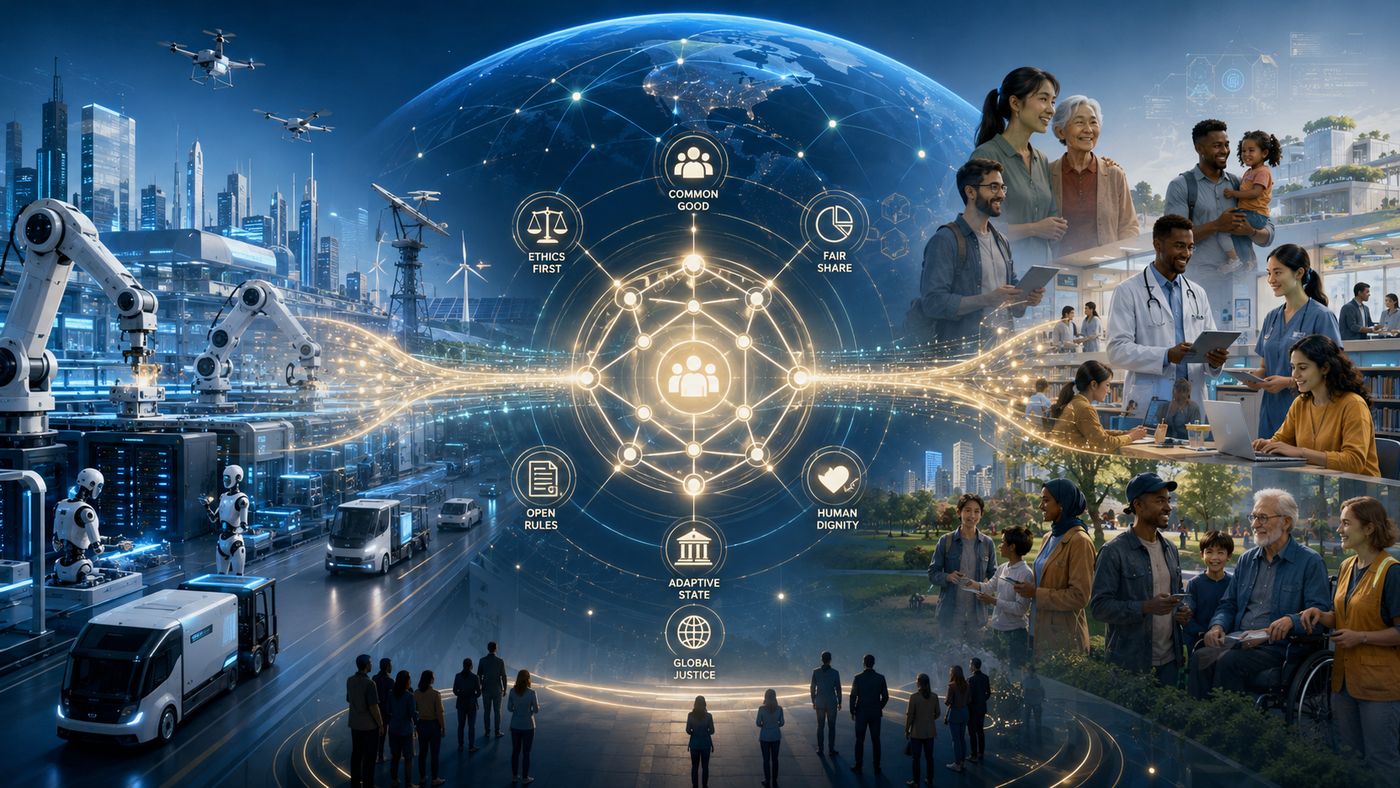
Common Good
We affirm the priority of the common good over narrow private interest wherever technologies reshape the lives of entire societies.
Fair Share
We affirm that every person has the right to a fair share of the benefits generated by automation, robotics, artificial intelligence, and digital transformation. These technologies rest upon humanity’s accumulated knowledge, infrastructures, institutions, and culture. Their gains therefore cannot remain the monopoly of the few.
Human Dignity
We believe that human dignity must not depend solely on market utility. Even in a deeply automated world, every person retains the right to participation, security, respect, and a dignified life.
Open Rules
Technologies that reshape societies must operate by rules that society can read, question, and enforce. Distribution cannot happen in the dark — it must be transparent, verifiable, and immune to private capture.
Adaptive State
We believe that the role of the state in distributing and redistributing social goods must be rethought in the public interest. The state must not disappear; it must evolve and adapt to the new technological reality.
Ethics First
We believe that ethical questions raised by new technologies must be answered by society — not left to corporations or governments alone. And they must be answered before the damage is done. The rules of the technological future must be open, contested, and accountable to all.
Global Justice
We hold that global technological progress requires global justice. The new era must not deepen the divide between countries, regions, and communities.
These seven principles are, we believe, both necessary and sufficient. Necessary — because without any one of them, the system we are building loses its integrity. Sufficient — because together they define everything a fair technological future requires. Not more. Not less.
What We Do
We are at the beginning of a long road. We do not have all the answers — and we are honest about that. What we have is a direction, a structure, and the conviction that starting is better than waiting for certainty.
We research.
We map where automation creates new value, who captures it, and who is left out. We make this visible — through data, publications, and public conversation.
We advocate.
We translate research into media, policy proposals, and civic pressure. We believe the distribution of technological gains must become a matter of real politics, not academic debate.
We pilot.
Some communities are already living the future we are describing — not only because of automation, but because of displacement, exclusion, and broken systems. We start there. With them. Because the tools built for those who have the least margin for error will work for everyone else too.
We operate transparently.
We govern transparently. All decisions are visible, rules are verifiable, and no single actor can capture the mission. We use a DAO — a decentralized autonomous organization — because a movement demanding accountability cannot itself operate in the dark.
This is how we work. The systems that will govern the age of automation are being built right now, by a small number of people, without public input. There is still time to change that — but not much.
What We Call For
No institution will do this for us. No government will wake up one morning and decide that the gains of automation belong to everyone. No corporation will voluntarily share what it has spent billions to build. This future — if it is to be fair — will be made by people who decided it mattered. People like you. Each one necessary. None sufficient alone.
If you are a journalist or writer — cover this.
The story is real, the people are real, and the question will not go away.
If you are a researcher or academic — join us.
We are building a research agenda and need serious minds.
If you are a donor or foundation — fund the first pilot.
We know where to start and we are ready.
If you simply believe this matters — sign and share.
Movements begin with people who refused to stay quiet