
by Dr. Andrejs Berdnikovs, aka Andrey P. Berdnikov
Today, the traditional nation-state no longer serves humanity – it restricts, surveils, taxes, and coerces. Centralized banks operate as extractive rent-seekers, freezing accounts at the behest of authoritarian regimes. Big Tech platforms act as panoptic monopolies, monetizing attention while manipulating cognitive biases. Simultaneously, digital "mobs" enforce ideological orthodoxy through cancel culture, targeting dissidents, refugees, and independent thinkers.
To escape this apparatus of control, we must construct parallel institutions. We do not need to overthrow incumbent monopolies or dictatorships; instead, we must render them obsolete through counter-economics, mutual aid, and cypherpunk code.
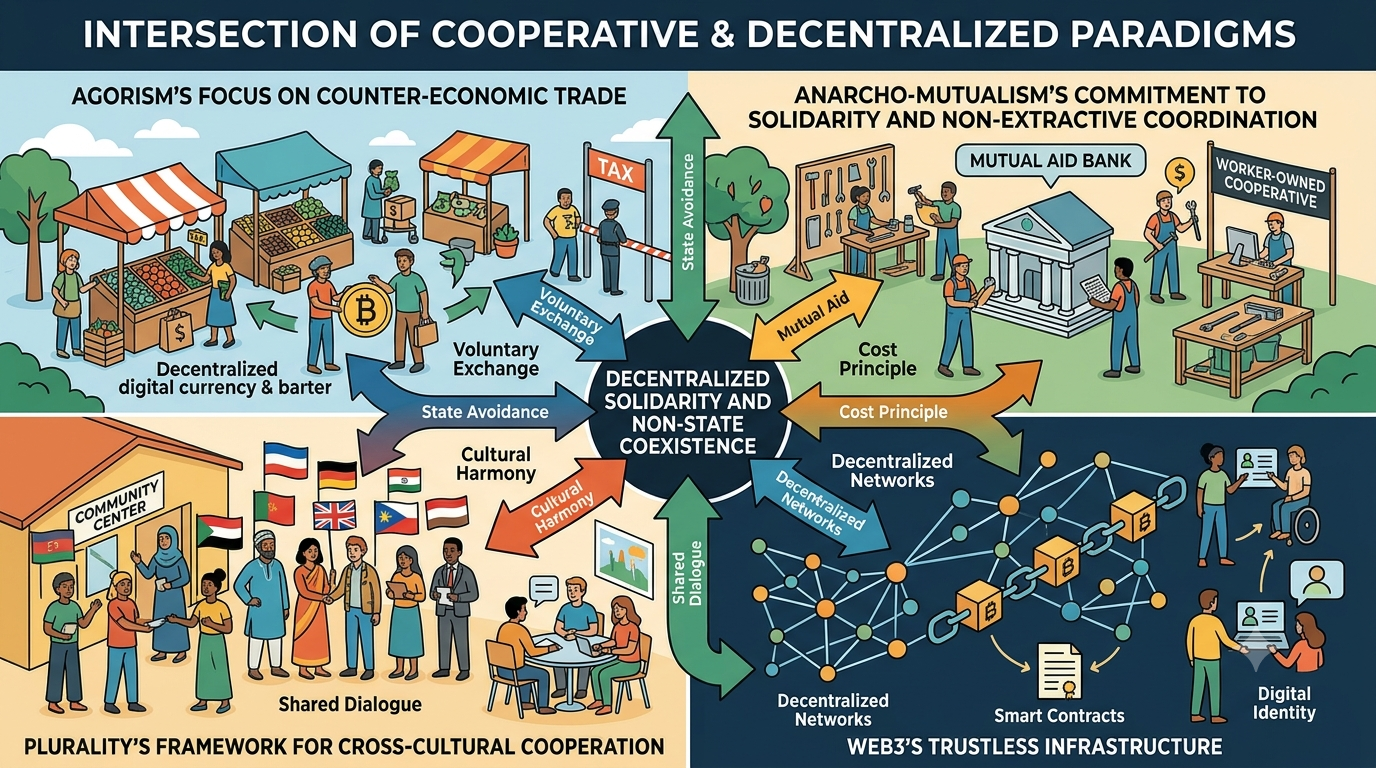
By synthesizing Peter Kropotkin’s vision of stateless communal federations, Samuel Edward Konkin III’s agorism, E. Glen Weyl’s concept of Plurality, and modern Web3 primitives, we can build a resilient, decentralized society (DeSoc).
Communes and Agoras: Structuring Pluralistic Freedom
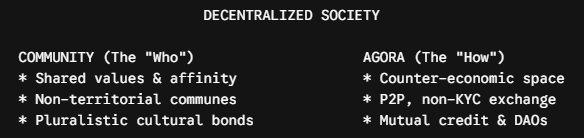
A thriving decentralized society relies on a clear conceptual distinction between two foundational elements: Community and the Agora.
Community: The Social Fabric
A community represents the human body – people bound by shared values, affinity, culture, religion, or shared experiences of exile and displacement.
In Words of a Rebel (1885), Peter Kropotkin redefined the "commune" not as a walled, territorial city-state, but as a voluntary grouping of equals without geographic borders. In a Web3 context, these non-territorial communes emerge as Decentralized Autonomous Organizations (DAOs) and digital diasporas. They cross state borders effortlessly, allowing individuals to form alliances across physical distances based on shared needs and mutual aid rather than state-enforced nationality.
The nation-state inherently fails at providing true Plurality – the framework described by E. Glen Weyl that honors, recognizes, and empowers cooperation across deep social differences. Because states rely on zero-sum majoritarian rule, one dominant group inevitably oppresses minority populations. Stateless, self-sovereign communities, by contrast, allow diverse groups to coexist peacefully without forcing cultural or ideological assimilation.
The Agora: The Technical Infrastructure
The Agora is the neutral, borderless infrastructure enabling commercial and civic life. It is the realm of counter-economics: untaxed, un-monitored, voluntary peer-to-peer (P2P) exchange.
While a community is structured around human relationships, the Agora is structured around tools, protocol rails, and economic exchange. Within Web3, the modern Agora provides the financial and organizational architecture for parallel survival, for example:
- Mutual Credit Networks: Non-extractive lending platforms built on social graphs rather than predatory interest rates.
- Decentralized Mutual Aid Pools: Smart-contract-driven safety nets that pool capital for medical emergencies, legal defense, and disaster relief.
- DePIN & Mesh Networks: Physical hardware infrastructure operated by community members (grid maintainers) to exchange computing power or bypass centralized telecommunications monopolies.
Simply put: The Agora is the network you access; the Community is the collective you belong to.
The Architecture of Trust: Web3 Alternative Reputation Systems
State regulators, centralized credit bureaus, and social media platforms maintain predatory reputation systems designed to enforce compliance, punish dissent, and marginalize vulnerable populations.
An agorist alternative reputation framework rejects state loyalty and political orthodoxy. Instead, it evaluates mathematical reliability, peer attestations, and risk metrics using Soulbound Tokens (SBTs), Verifiable Credentials (VCs), and Zero-Knowledge Proofs (ZKPs).
To allocate aid and establish trust across pseudonymous networks, we implement a Multidimensional Trust Framework:
Trust Dimension | Operational Definition | Verification Engine |
|---|---|---|
Uniqueness | Confirms the user is a real human and not a sybil/duplicate account. | Web-of-trust guarantors, peer attestations, and ZK-biometric verification. |
Community Connection | Verifies active participation in a specific diaspora, affinity group, or DAO. | On-chain credentials issued by peer community members. |
Case Authenticity | Confirms the validity of an individual's claim or emergency situation. | Vouched for by local guarantors, documentation, and peer interviews. |
Need Severity | Evaluates the gravity and objective impact of the requested assistance. | Assessed by peer-elected community evaluators. |
Urgency | Measures the timeframe required for emergency response or aid distribution. | Managed via automated DAO priority routing algorithms. |
Evidence Confidence | Assesses the completeness, consistency, and integrity of provided data. | AI-assisted verification models coupled with independent peer auditors. |
Fraud Risk | Analyzes patterns to detect potential collusion, forgery, or sybil manipulation. | On-chain graph analytics, AI auditing tools, and community consensus. |
Donor Integrity Risk | Evaluates potential security or regulatory risks tied to incoming funds. | Privacy-preserving source analysis and compliance verification protocols. |
Decision Status | Final governance state (Approved, Conditional, Deferred, Rejected). | Execution via smart contract logic or collegial DAO vote. |
By separating identity from state-issued documents, a stateless person can build an un-censorable reputation profile that travels with them anywhere in the world.
Digital Rights in Web3 Agoras
In legacy systems, "rights" are privileges granted – and frequently revoked – by state authorities. In a cypherpunk framework, digital rights are not legal petitions; they are mathematically enforced capabilities built directly into code.
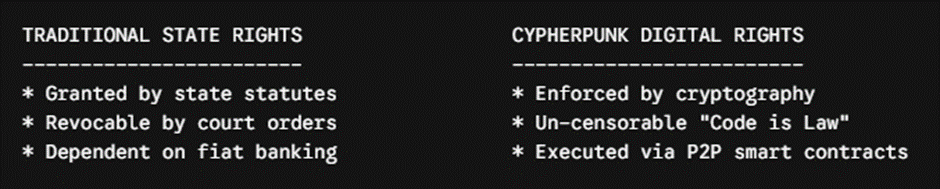
Stateless communities and Web3 agoras require five foundational digital capabilities:
The Right to Exist and Transact
Every human possesses an inherent right to an un-censorable, self-sovereign digital existence. Through Decentralized Identifiers (DIDs) and Soulbound Tokens, stateless individuals maintain a permanent "proof of existence," credential history, and credit rating independent of state birth certificates or passports.
The Right to Financial Autonomy and Association
Financial surveillance is a primary tool of political suppression. By deploying privacy-preserving smart contracts, zero-knowledge proofs, and non-custodial P2P liquidity pools, individuals can raise funds, trade value, and organize mutual defense without interference from banking cartels or state tax agencies.
The Right to Knowledge and Data Sovereignty
To defeat platform feudalism, information must remain a digital commons. Web3 agoras rely on open-access, user-owned protocols (e.g., IPFS, Arweave) and decentralized publishing systems that prevent algorithmic manipulation, shadowbanning, and corporate enclosure of knowledge.
The Right to Digital Resilience via Social Recovery
Loss of private keys or hardware confiscation by hostile authorities should not mean digital execution. Through Social Recovery Guardians – a trusted web of peers, community members, or mutual aid cohorts – a user can cryptographically recover their identity, reputation profiles, and assets without relying on centralized corporate support desks or state registrars.
The Right to Difference and Pluralistic Coexistence
Web3 tools protect the freedom of minority groups and individuals to preserve their unique traditions, languages, religions, and identities on-chain, empowering them to co-design self-governed digital communities and agoras rather than facing state or Big Tech platforms-driven algorithmic assimilation.
Conclusion: Building the Parallel World
We cannot audit state power into benevolence, nor can we reform predatory financial institutions from within. The cypherpunk mandate has always been clear: if we want privacy, freedom, and human dignity, we must write the code that guarantees them.
By combining Agorism’s focus on counter-economic trade, Anarcho-Mutualism’s commitment to solidarity and non-extractive coordination, Plurality’s framework for cross-cultural cooperation, and Web3’s trustless infrastructure, we can build the stateless agoras and federated communes that will ensure human freedom and dignity across state borders.