
by Dr. Andrejs Berdnikovs, aka Andrey P. Berdnikov
CROPS Against the Control Machine
The post-labour class war raging inside the Ethereum architecture remains fundamentally a battle over Control. This is the ultimate structural conflict between the Decentralizers (d/acc) and the unbridled Accelerators (e/acc).
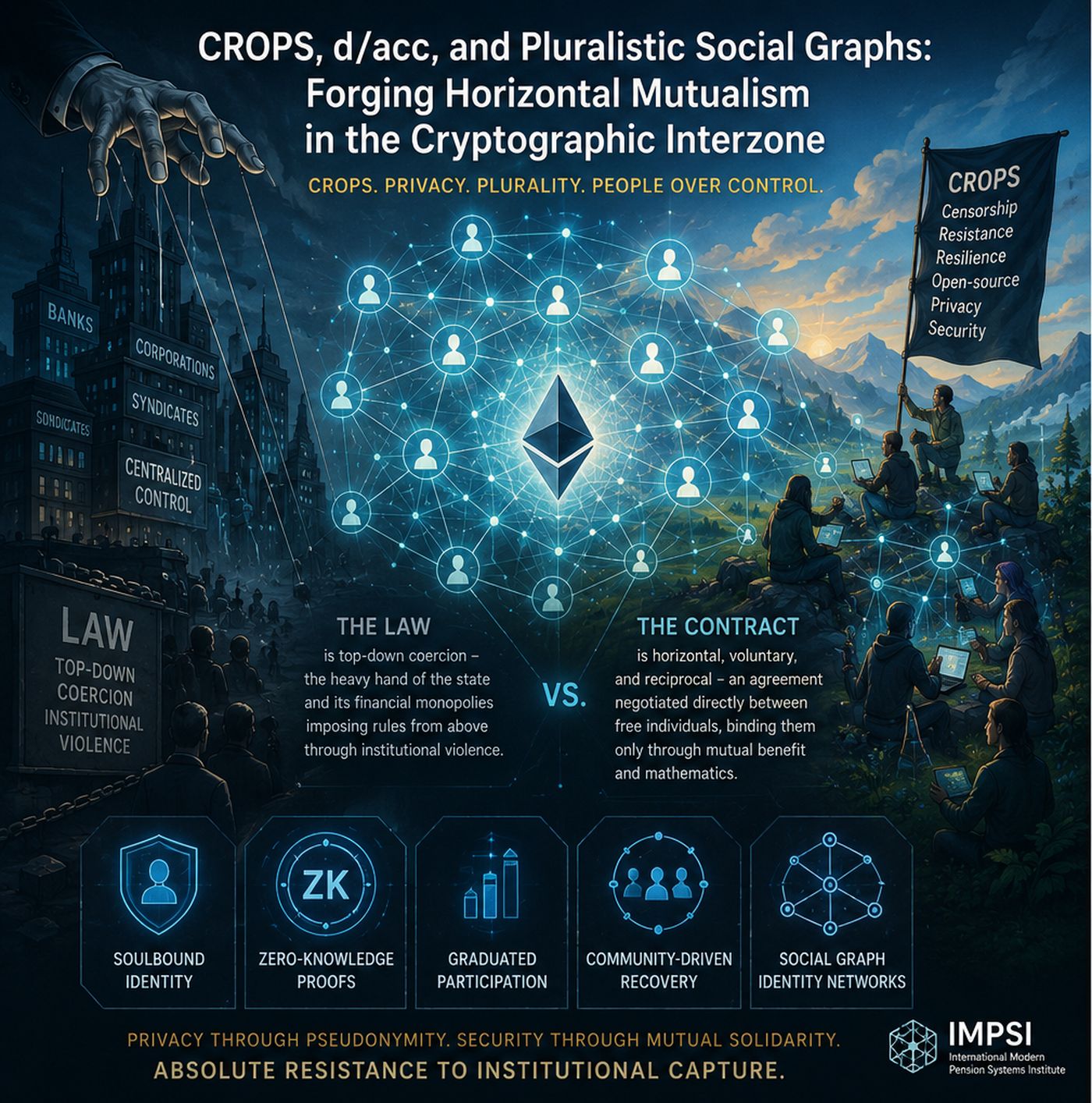
On one side stands the newly re-crystallized cypherpunk mission: CROPS (Censorship resistance, Resilience against capture, Open-source development, Privacy, and Security). This is a hardline declaration of network self-sovereignty, prioritizing the integrity of decentralized infrastructure over the frantic chase for low fees and high transaction speeds.
On the other side are the institutional behemoths – mega-banks, corporate and asset-management entities, centralized tech conglomerates, the all-powerful boards and syndicates of the earth. They are attempting to colonize public ledger space, trying to appropriate Ethereum as mere "financial middleware" to interlock their internal, permissioned networks. They demand a sanitized ecosystem optimized for liquidity, swift price action, and top-down regulatory compliance protocols.
The Ghost of Proudhon: Horizontal Contract vs. Vertical LawThe very concept of the smart contract was designed to inject the anarchist mutualism of Pierre-Joseph Proudhon straight into the digital fabric. Proudhon drew an absolute line across human history:
- The Law is top-down coercion – the heavy hand of the state and its financial monopolies imposing rules from above through institutional violence.
- The Contract is horizontal, voluntary, and reciprocal – an agreement negotiated directly between free individuals, binding them only through mutual benefit and mathematics.
The institutional entities want to subject the horizontal smart contracts to the vertical logic of the Law. At IMPSI (MTÜ Pensionisüsteemide Instituut), we are engineering an escape from this centralized trap.
The Ghost of SEK3: Agorism and Counter-Economic Architecture
Samuel Edward Konkin III (SEK3) evolved the principles of mutual exchange to confront an institutional reality that Proudhon could never have anticipated: the rise of the modern, fiat-backed corporate warfare state and its totalizing regulatory surveillance grid. Konkin argued that a stateless, decentralized society built on mutualism could never be achieved by voting or compromising with top-down political machinery. Instead, it must be carved out through Counter-Economics – the deliberate practice of engaging in voluntary, peaceful, and non-state-sanctioned exchanges across black and grey markets to obsolete the Control Machine from below.
While Konkin’s radical vision of Agorism remained largely localized and theoretical during his lifetime, the digital revolution and the birth of cryptography breathed unstoppable life into the counter-economic narrative. Cryptocurrencies and decentralized execution layers turned Agorist theory into a tangible reality, providing the exact alternative economic infrastructure needed to execute trustless peer-to-peer commerce outside the state's visibility and tracking systems.
Mutual Plurality
This evolutionary lineage charts a direct trajectory toward absolute systemic autonomy:

This structural progression brings us to our concept of Mutual Plurality. By synthesizing Proudhon’s mutualism, SEK3’s counter-economics, and E. Glen Weyl’s plurality, we move away from atomized individual isolationism toward a resilient network of self-sovereign, cooperating enclaves.
Ultimately, the CROPS agenda serves as the definitive programmable substrate for this entire lineage. CROPS provides the real-world, immutable framework required for the formal on-chain implementation of Anarcho-Mutualism, Counter-Economics, and Plurality – converting radical political philosophy into un-jammable, production-grade code.
The Mutual Plurality Network System Build
Our production repository embodies an operational implementation of the CROPS. While our "Mutual Plurality” DAO dApp prototype has already successfully integrated its core technical foundation, we are actively expanding its architecture to accommodate the next generation of social-graph infrastructure.
What we have built so far:
- Soulbound Token (SBT) Ecosystem: Establishing permanent, non-transferable on-chain identities that track relational community contributions without relying on legacy, centralized identification systems.
- Zero-Knowledge (ZK) Proof Mechanisms: Enabling cryptographic membership validation and access rights while preserving absolute user pseudonymity.
- Graduated Participation Tiers: Structuring access control so that a user’s systemic velocity and resource privileges scale dynamically with their verified, multi-layered contributions to the collective network.
- Community-Driven Social Recovery: Eradicating the vulnerability of private seed phrases or administrative backdoors. Access recovery is entirely managed through user-designated peer circles.
What we are engineering next:
- Social-Graph-Based Pluralistic Identity Networks: Shifting identity away from isolated accounts toward a dynamic, living web of human interpersonal validations.
By mapping cryptographic addresses without ever anchoring them to real-world names, this model fully realizes the pluralistic vision of a decentralized society (DeSoc). There are no master seeds to steal, and no centralized administrative recovery tools for a hostile state apparatus to subpoena. Access to a wallet – and one's standing within the community – can only be restored when the intersecting paths of your chosen human guardians converge to cryptographically vouch for your identity once more. This is privacy through pseudonymity, security through mutual solidarity, and absolute resistance to institutional capture.
The Interzone Paradox: Cultural Cohesiveness vs. Privacy
Our conceptual framework maps directly to the paradigm of Plurality, proposed by E. Glen Weyl and Vitalik Buterin – a technological landscape designed to facilitate cooperation across deep social, cultural, ideological, and linguistic divides without sacrificing individual distinctiveness.
However, as we develop infrastructure for our self-sovereign, culturally unified DAO, we run into a profound cryptographic paradox driven by Ethereum’s push toward total privacy.
If every participant joins a culturally cohesive DAO as a completely blank, untraceable, context-free cryptographic ghost, the community loses its relational glue. An enclave (e.g., an anarchist collective, a religious community, or a migrant mutual aid group) becomes entirely vulnerable to automated Sybil swarms, state-sponsored bot attacks, and hostile takeovers designed to distort consensus.
Conversely, if the DAO requires you to surrender your real-world identity, name, or geographic location to prove you belong to the enclave, individual privacy is liquidated. The Control Machine logs your coordinates.
The Zero-Knowledge Shield: Membership Without Identification
The Control Machine operates by forcing false choices: total transparency or total blindness. We cut through this dichotomy by separating Anonymity (having no identity, being an untraceable non-entity) from Privacy (retaining sovereign, subjective control over how and to whom your identity details are broadcast).
Zero-Knowledge Proofs (ZKPs) enable membership proofs without identification.

The on-chain pipeline in practice:
- The Local Attestation: You exist within a localized, trust-centric human collective. A localized peer node or decentralized web-of-trust issues a cryptographic credential directly into your private wallet container.
- The Zero-Knowledge Shield: When you enter the public, self-sovereign DAO to vote, coordinate, or trigger resource allocation, you do not expose your wallet history, your real name, or the identity of the node that vouched for you.
- The Proof: Your client interface generates an on-chain ZK-proof that states: “I mathematically possess a valid membership credential issued by an authorized community node, but which specific individual I am is beyond your data-harvesting clearance.”
The DAO remains culturally cohesive and insulated against malicious scripts, while the individual retains absolute cryptographic pseudonymity.
The Interstitial Social Graph: Destroying the Biometric Control Grid
There is a sinister dominating trend currently pushed by the Control Machine of centralized tech conglomerates: the “one-identity-per-person” biometric tracking model. Eyeball scanners, centralized facial recognition databases, and digital health passports.
However, identity is not an isolated piece of flesh to be indexed, digitized, and filed away by governments or corporate monopolies. As Vitalik Buterin has accurately observed, identity is interstitial – it exists entirely between us, in the spaces, alliances, and relational trust lines we construct.
By explicitly prioritizing a decentralized social graph over a singular, global biometric database (such as iris-scanning networks or state-issued digital IDs), the architecture we are engineering at IMPSI (MTÜ Pensionisüsteemide Instituut) achieves three massive structural advantages:
- Resilience against state capture: If an oppressive state institution cancels your official passport or freezes your state identity, the decentralized social graph remains unaffected. The community memory persists on-chain, preserving your earned standing, your contributions, and your resource allocation tier.
- Sanctuary for the stateless: Migrants, refugees, second-class citizens, non-citizens, dissidents, outcasts, marginalized individuals, and other wretched of the earth stripped of institutional documentation are instantly integrated. If the horizontal network knows your credentials and your work, you cryptographically exist.
- Sybil immunity: An adversary running an AI rig can spawn 10,000 blank wallets in seconds, but they cannot manufacture the deep, multi-layered human history required to weave those digital ghosts into a living, breathing social graph.
Traditional communities preserved their autonomy and security across centuries without state police, central registries, or identity papers by relying on exactly this: elders vouching for members, and members testing newcomers through graduated contributions.

As noted, the implementation of the Interstitial Social Graph represents the next phase of our prototype's development. Full technical documentation, codebase files, and deployment scripts are available in our GitHub repository.
IMPSI develops models where machine productivity funds human welfare.